Hajime Font Duo: Where Modern Edge Meets Handwritten Soul
There’s a specific kind of tension in design that works beautifully—the contrast between something engineered and something organic. Think of a modern gallery space with raw wood floors, or a tech startup logo that feels personal. This is the exact energy the Hajime Font Duo brings to your projects. It pairs a condensed, architectural sans-serif with a fluid, natural script. One font handles the structure; the other brings the emotion. For anyone building a brand, designing packaging, or creating marketing assets, this combination solves a common problem: how to look both professional and human at the same time.
The Anatomy of a Balanced Typeface
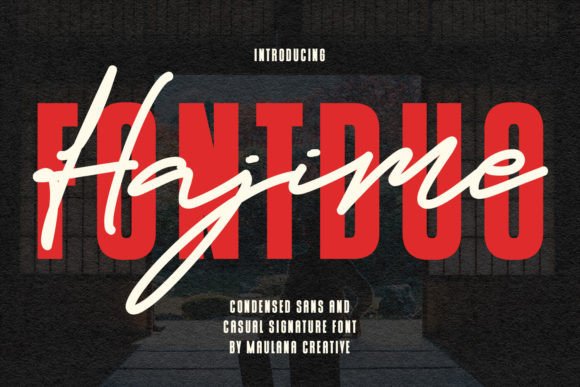
Let’s break down what you’re getting. The sans-serif component is condensed, which means it has a tall, narrow structure. This is incredibly practical. It allows you to set headlines that are impactful without taking up excessive horizontal space, making it perfect for logo lockups, website banners, or poster titles where real estate matters. The letterforms are clean and modern, with a sleekness that feels current without being trendy in a way that will date quickly. It’s the kind of display font that gives a brand immediate credibility and clarity.
Then you have the script. This isn’t a formal, calligraphic hand—it’s a handwritten font with a natural, slightly imperfect flow. The strokes have a personal touch, as if signed by the creator. This is the font you use for taglines, accents, or any element where you want to inject warmth, authenticity, or a sense of craftsmanship. The magic happens when you use them together. The contrast creates a visual hierarchy that guides the eye and communicates on multiple levels: the sans-serif delivers the core message with authority, while the script adds a layer of personality and approachability.
Practical Applications Beyond the Mockup
Seeing a font duo on a specimen sheet is one thing. Understanding how it functions in the wild is another. Here’s where Hajime truly shines as a set of design assets.
For brand identity, this duo is a powerhouse. Use the condensed sans-serif for your primary logo wordmark. It’s strong and memorable. Then, pair it with the script for your brand’s tagline or secondary logo variation. This instantly gives your brand a versatile system. On packaging design, the sans-serif can list product details or ingredients with excellent readability, while the script can highlight the product name or a key benefit (“Artisan,” “Small Batch”) to create an emotional hook on the shelf.
When it comes to digital presence, the applications are endless. On a website, the sans-serif is ideal for navigation menus, headings, and buttons—anywhere you need crisp, fast legibility. The script can be used sparingly for quote callouts, author names in a blog, or special announcement banners to break the visual monotony. For social media graphics, this font pairing is a secret weapon. The condensed sans-serif fits more text into Instagram story dimensions or Pinterest pins, while the script can add a personal, handwritten note to a promotional post or a testimonial graphic. It helps maintain visual consistency across your feed while keeping it dynamic.
Don’t overlook print and editorial design. In a magazine layout or a lookbook, the sans-serif can create strong, clean pull quotes and section headers. The script can introduce a feature story or add a stylistic note to a page number. For posters and event invitations, the combination allows you to establish the event name with the bold sans-serif and then detail the location and date with the elegant script, creating a balanced and inviting composition.
Matching Fonts to Your Creative Goals
Choosing a font duo like Hajime isn’t just about aesthetics; it’s a strategic decision. Ask yourself what you want your project to feel like. If your goal is to appear innovative, sleek, and forward-thinking, lean heavily on the condensed sans-serif. If you’re building a brand for a café, a boutique, or a handmade goods store, using more of the script will convey that handmade, personalized vibe. The best results often come from using both, but in varying degrees of emphasis.
A critical piece of practical advice: always test your typography in context. Don’t just look at the letters on a design software artboard. Set your actual headlines, your real body copy, your true contact information. Check the readability of the sans-serif at small sizes for captions or footer text. See how the script flows when you type out a longer phrase—does it connect naturally? Does it maintain legibility? Print out a test page. View a mockup on your phone. Good typography should be functional, not just decorative.
Also, consider the ecosystem of your project. Hajime is a premium font, which typically means it comes with a commercial license for widespread use. This is crucial if you’re using it for a client’s logo, on merchandise for sale, or in a digital product you plan to distribute. Always review the license agreement included with your font files. Understanding whether it covers web fonts, app usage, or physical products will save you legal headaches down the line and ensure your professional presentation is built on solid ground.
Building a Cohesive Visual Language
Ultimately, the value of a well-chosen font duo like Hajime is in its ability to help you build a cohesive visual language. Consistency is what transforms a collection of designs into a recognizable brand. When you use the same two typefaces across your website, your business cards, your Instagram stories, and your product packaging, you create a subconscious pattern for your audience. They start to recognize you before they even read the words. That’s brand recognition in action.
This font pairing also improves audience engagement. The human eye is drawn to contrast and variety. A page set entirely in one typeface can become visually flat. By introducing the handwritten script as an accent, you create points of interest that draw the reader in and make the design feel more layered and thoughtful. It’s a subtle way to hold attention and make your communication feel more direct and personal.
Think of Hajime not as two separate fonts, but as a single, flexible design system. The sans-serif is your workhorse for clarity and impact. The script is your tool for expression and nuance. Used together, they give you the power to communicate complex brand messages—professional yet personal, modern yet timeless, structured yet free-flowing—all within a unified typographic framework. It’s about having the right tools to tell your story with both precision and heart.